The Hidden Math Behind Greenhouse Decisions
The Hidden Math Behind Greenhouse Decisions

You're standing in a garden center looking at a $2,000 DIY greenhouse kit. Next to it, a brochure for custom builds starting at $10,000. The choice seems obvious.
But the sticker price tells you almost nothing about what you'll actually spend.
We analyzed total cost of ownership data across hundreds of greenhouse installations over 5-10 years. The findings challenge the assumption that DIY always means savings. When you factor in hidden system costs, retrofits, and performance gaps, that "cheap" kit often becomes the more expensive choice.
The Real Cost Emerges After Year One

A typical DIY kit runs $500 to $2,000 upfront. That's the number that gets your attention.
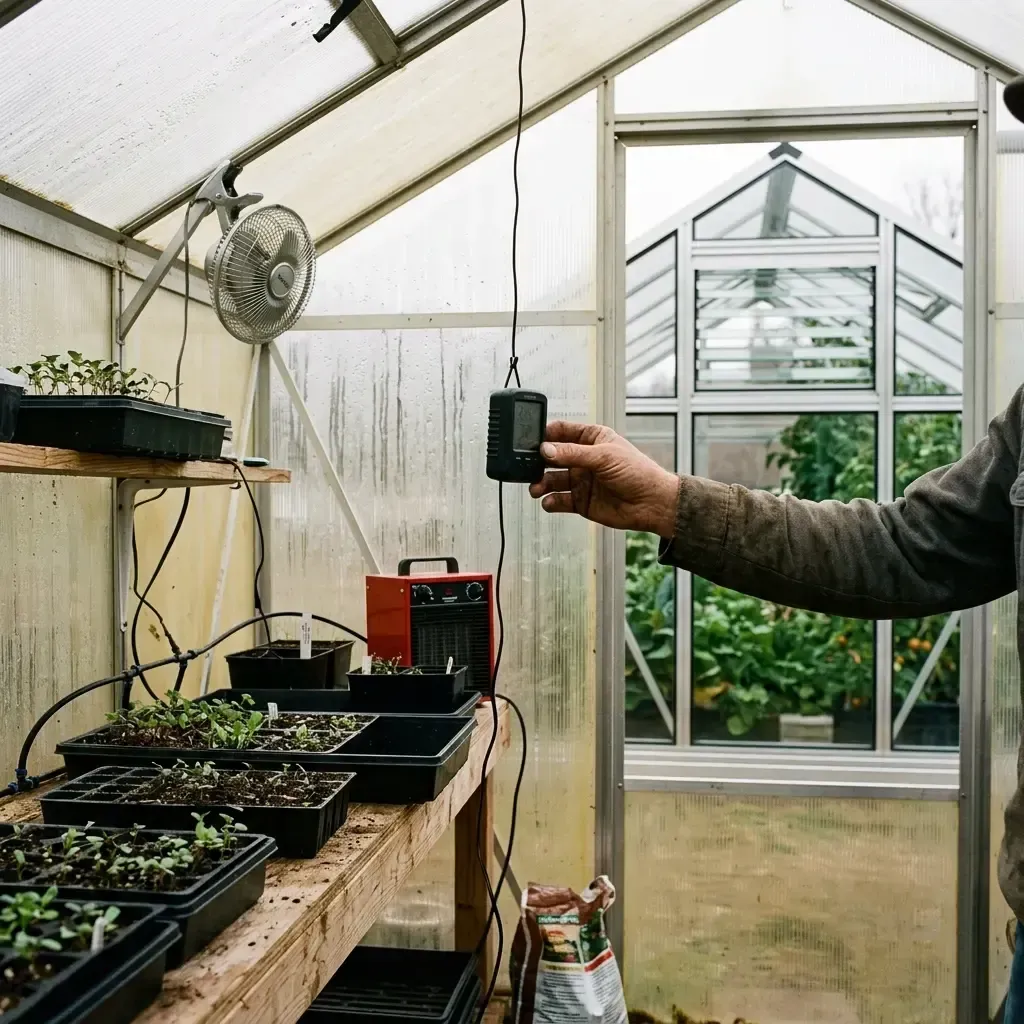
But the structure is just the beginning. You still need temperature controls, irrigation systems, shelving, grow lights, and environmental monitors. These essentials add up fast:
Temperature controls (fans and heaters): $330-$1,280
Automated irrigation and timers: $225-$1,000
Interior setup (shelving, lights, monitors): $350-$1,700
Early maintenance and repairs: $70-$300 per year
Your total investment in the first few years climbs to $1,500-$6,000 or more. That doesn't include utilities, seeds, or crop expansion.
The kit that seemed like a bargain now approaches the cost of a mid-level custom greenhouse that comes with these systems built in.
The Psychology of Incremental Spending

There's a behavioral pattern at work here. Behavioral economists call it the "pain of paying now versus later" trap.
The DIY kit feels approachable. Low-stakes. You tell yourself you'll optimize as you go, adding systems when you need them. This gives you a false sense of control and flexibility.
But each addition is a mini retrofit with diminishing returns.
You install a heater. Then a fan. Then grow lights. Each in isolation, without understanding how the components interact. Temperature swings create microclimates. Humidity spikes stress plants. Uneven airflow reduces yields.
The approach breaks down first in environmental control and scheduling. You're reacting to problems instead of managing a system.
When the System Fails
Most growers don't realize they've crossed the cost threshold overnight. It builds gradually.
Then comes the triggering event.
A scheduled harvest fails. Seedlings die from uneven heat. Microgreens bolt because the light cycle was off. A planned delivery can't happen because the irrigation system failed.
Suddenly, the cost of lost crops and emergency upgrades becomes concrete. You tally the cumulative spending on patchwork fixes and realize you've spent as much or more than a professionally designed system would have cost upfront.
Research shows these retrofits push total spending to 1.5-2× the cost of a custom greenhouse.
The Retrofit Reality

When growers commit to fixing their failing system, they usually salvage the frame but rebuild everything inside:
Benches and shelving repositioned for efficient crop flow
Irrigation replaced or fully automated
Heaters and fans integrated into coordinated climate control
Lighting adjusted for proper coverage and timing
Insulation and ventilation upgrades added
It's labor-intensive and requires careful planning. The internal overhaul transforms a failing setup into a scalable production system.
But you've paid twice. Once for the piecemeal approach. Again for the integrated overhaul.
The Performance Gap in Years 3-5

Even after paying to fix initial missteps, the retrofitted greenhouse rarely catches up fully.
The original incremental approach leaves lingering compromises. Suboptimal airflow patterns. Slightly misaligned irrigation runs. Space constraints that limit crop density.
A custom-built system starts with optimized layouts, integrated climate control, properly staged crop areas, and reliable irrigation and lighting. By year three, it's producing at peak capacity with minimal downtime and predictable yields.
The retrofit grower might see similar revenue with exceptional effort. But they face more ongoing maintenance, occasional crop stress, and higher labor per unit of output.
The well-planned system converts the same space into higher and more consistent production with less wasted effort.
When DIY Actually Makes Sense

The kit approach isn't wrong for everyone.
It makes sense for beginner growers, hobbyists, or side-hustle entrepreneurs testing both their interest and the market. These buyers typically have:
Limited upfront capital
Small spaces or seasonal intentions
Uncertainty about scaling
Interest in hands-on learning
The lower initial cost lets you experiment with planting schedules, crop types, and environmental control without risking a big investment.
The key is recognizing the trade-off. You're saving money upfront but accepting higher labor, patchwork upgrades, and potential inefficiencies later.
This approach is justified when the primary goal is learning or market testing, not maximizing production efficiency.
Signals That It's Time to Transition

The signals show up in both demand and operational strain:
Demand signals:
You consistently sell out of what your kit can produce
Customers ask for more volume, frequency, or reliability
Recurring revenue hits a ceiling
Operational signals:
Airflow issues, temperature swings, water management challenges
Spatial limitations forcing constant workarounds
Labor intensity rising disproportionately
Crop losses or inconsistent harvests
Customer signals:
Late deliveries
Limited product variety
Inability to serve multiple buyers reliably
When these converge, staying in "testing mode" risks the costly cascade of failures we described earlier.
The Financial Trigger Point
There's a specific revenue threshold where the math clearly says "invest in custom now."
For small greenhouse operators, this typically occurs once recurring monthly revenue reaches $1,500-$3,000, depending on crop type, market, and operating costs.
At this point, your profit margins should be healthy enough (typically 40-60% gross margin) that reinvesting in a fully integrated system is financially feasible.
The math shows that continuing to layer fixes on a kit costs not just money but labor, lost crops, and inefficiencies. A custom build consolidates those costs into one upfront investment that increases output, reduces labor per unit, and stabilizes production.
When the cost of incremental fixes approaches or exceeds the cost of a properly designed system, and your revenue is high enough to fund that investment without jeopardizing cash flow, that's your signal.
The Biggest Misconception

The single biggest misconception we see is that growers believe they can keep "optimizing as they go" indefinitely without hitting real limits.
They think incremental fixes and patchwork upgrades will eventually get them to the same performance as a custom system.
Many growers cling to the idea that DIY kits are flexible and low-risk. They underestimate how hidden costs, crop stress, labor intensity, and environmental inefficiencies compound over time.
They think that because they've invested in the structure already, adding another fan, light, or irrigation line is "just a small tweak."
In reality, each patch is a mini retrofit with diminishing returns.
This mindset delays the transition to a custom, integrated system until frustration and lost revenue force their hand. Often after they've spent 1.5-2× what a proper build would have cost.
The misconception is that time, effort, and money can substitute for systemic design. The reality is that performance, reliability, and scalable profitability require a purpose-built setup once demand and revenue reach a certain threshold.
What to Consider Right Now

If you're standing in that garden center looking at a $2,000 DIY kit versus saving for a $10,000 custom build, consider this:
Calculate your total cost of ownership, not just the sticker price.
Add up the hidden systems you'll need. Factor in the time you'll spend troubleshooting environmental imbalances. Consider the revenue you'll lose from inconsistent crops or late deliveries.
Ask yourself if your goal is learning and market testing, or building a reliable revenue-generating operation.
If it's the former, a kit makes sense. If it's the latter, the data shows that starting with a properly designed, integrated system saves you money, time, and stress over the long term.
The choice isn't just about what you can afford today. It's about what you'll actually spend over the next five years, and what kind of production system you'll have at the end of that investment.
Most people overlook the compounding costs of incremental fixes. The data reveals a different story than the sticker price suggests.
Your decision should be based on total cost of ownership, your revenue goals, and when you plan to transition from testing to scaling.
The math doesn't lie. The question is whether you'll learn it the easy way or the expensive way.